History / Navy science and technology
Science and technology in the Brazilian Navyfrom 1763 to 2026
From the Royal Arsenal to the submarine built in Itaguaí: how the Navy came to produce the knowledge it uses, and where that line leads today, in the institutes and technologies of this Showcase.
- eras
- 7
- sourced milestones
- 94
- people
- 11
- institutes today
- 18
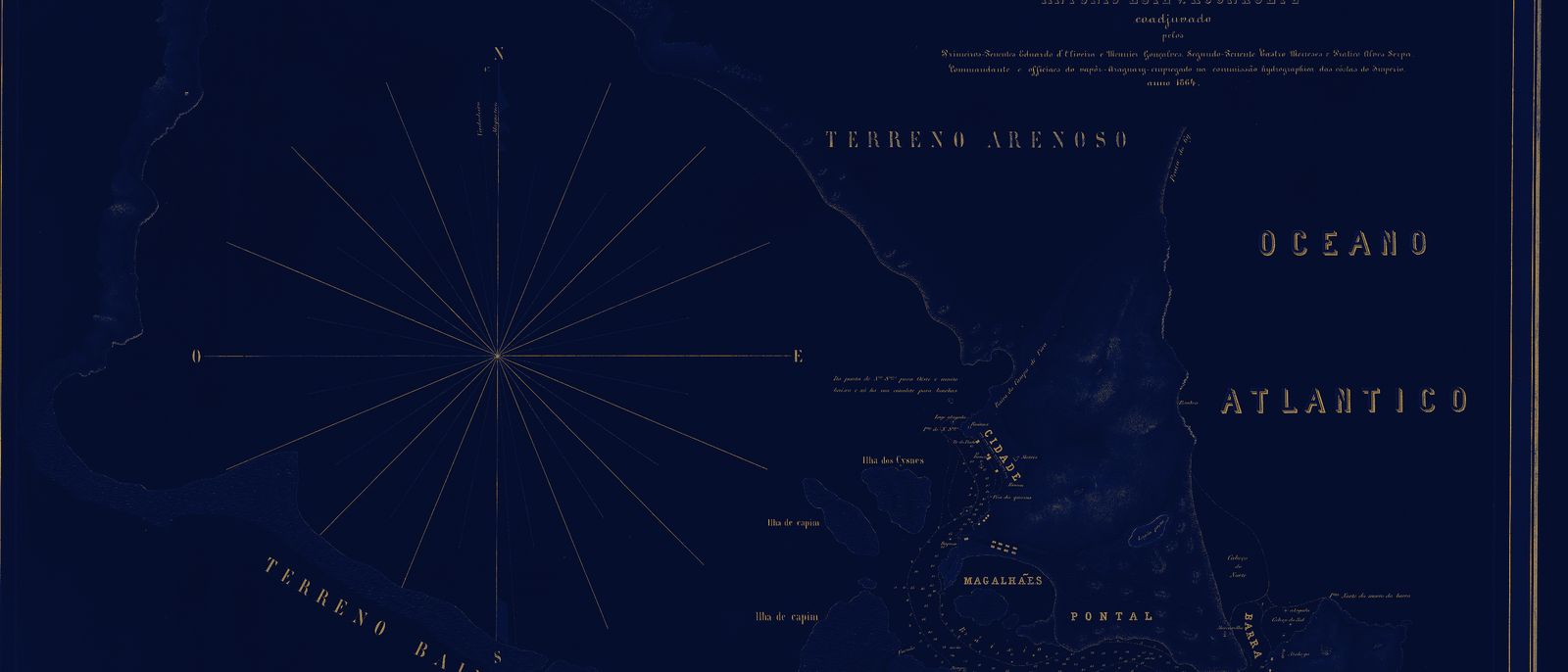
Hydrographic chart of Laguna, Santa Catarina, surveyed and drawn in 1864 by Lieutenant Antonio Luiz von Hoonholtz, later Baron of Teffé. Public domain
01 / Eras
Seven eras, one continuous line
Each era begins when the Navy starts to produce a capability, rather than only buy it, or when an institution that still exists today is founded.
- 011763 to 1821The shipyard and the academyThe Crown decides to build ships in the colony. With the court, in 1808, come the academy, the pharmacy and the shipboard troops.
- 021822 to 1889The imperial science of the seaThe Empire learns to chart its own coast and takes the Navy into international science.
- 031889 to 1945New technologies of the RepublicRadio, submarines and aircraft reach the Navy early, but its ships still arrive ready-made from abroad.
- 041946 to 1969Science as state policyThe postwar years convince the Navy that it needs its own laboratory and a national science policy.
- 051970 to 1989Frigates, computers and the seaA digital frigate program pulls along a computer, a company and a research center. The same period creates most of today's institutes.
- 061990 to 2007The Blue AmazonThe focus of naval science shifts from the ship to the maritime territory.
- 072008 to 2026An S&T system and industrial sovereigntyFrom three isolated institutes to a system of 18, as submarines, missiles and frigates come to be built in Brazil.
Era 1 1763 to 1821
The shipyard and the academy
The Crown decides to build ships in the colony. With the court, in 1808, come the academy, the pharmacy and the shipboard troops.
Driven by the gold of Minas Gerais and by conflicts in the South, the Portuguese Crown founds the Royal Navy Arsenal in 1763 at the foot of São Bento Monastery in Rio de Janeiro. Four years later the yard launches its first ship, the São Sebastião.
The court's move to Brazil in 1808 brings three seeds that last for centuries: the Royal Academy of Midshipmen, founded in Lisbon in 1782 to teach mathematics and navigation sciences; the Military Pharmacy, origin of the Pharmaceutical Laboratory; and the Royal Navy Brigade, the starting point of the Marine Corps.
That same year the Navy Ministry is set up, with a hospital, an archive and a gunpowder factory, and the Arsenal takes on the support of the newly arrived fleet.
Why it matters. Building, teaching and caring: the three callings the Navy still holds today all begin in this era.
Milestones 8
1763
The Royal Navy Arsenal is founded
The Count of Cunha founds the shipyard at the foot of São Bento Monastery in Rio de Janeiro. It is the origin of today's Navy Arsenal and of the practice of designing and building ships in Brazil.
1767
The ship of the line São Sebastião is launched
The first ship built by the Royal Arsenal, the São Sebastião, known as the “Serpent”, is launched four years after the yard was founded.
1782
The Royal Academy of Midshipmen is founded
Queen Maria I founds in Lisbon the academy that trains future Portuguese naval officers, with a curriculum of mathematics and sciences applied to navigation.

Atlas des Enfans, a 1784 edition that belonged to the Royal Academy of Midshipmen, now held by the Navy's heritage directorate (DPHDM). Photo by the Brazilian Navy, 2019.Brazilian Navy (official Flickr mboficial). CC BY-SA 2.0 processed image 1808
The Academy of Midshipmen arrives in Rio
The Academy crosses the Atlantic with the court, bringing students, teachers and records, and settles in São Bento Monastery until the 1830s. It moves to Villegagnon Island in 1938 as the Naval School.
1808
The Arsenal takes on the fleet's support
With the court's arrival, the Royal Arsenal is enlarged to support the fleet and, renamed the Court Navy Arsenal, takes charge of the Navy's funds and supplies in Brazil.
1808
The Royal Navy Brigade lands in Rio
Created in 1797, the brigade arrives with the royal court, sets up at the São José Fortress on Cobras Island and guards Navy facilities ashore. The date marks the birth of the Brazilian Marine Corps.
1808
The Navy Ministry is set up in Rio
The Ministry of Navy and Overseas Affairs is established in Rio. It is followed by the Fleet Headquarters, the Military Archive, the Navy Hospital and the Gunpowder Factory.
1808
The Military Pharmacy is created
A decree creates the pharmacy and places it under apothecary Joaquim José Carvalho. It is the origin of today's Navy Pharmaceutical Laboratory.
In the Showcase today
Institutes rooted in this era and what they offer now.
Era 2 1822 to 1889
The imperial science of the sea
The Empire learns to chart its own coast and takes the Navy into international science.
The Empire inherits Portuguese and French charts. From 1830, Brazilian officers survey the coast themselves; Vital de Oliveira charts the northeastern shore, and Hoonholtz, the future Baron of Teffé, writes the Compendium of Hydrography used at the Academy.
During the War of the Triple Alliance, Brazilian engineers design and build ironclads at the Court Arsenal. In 1876 the Hydrographic Office is created under Teffé, who in 1882 leads the Brazilian team observing the Transit of Venus.
In 1888 the Navy Ministry gains the Central Meteorological Office, the Empire's center for meteorology and terrestrial physics, which issues weather warnings to ports.
Why it matters. This is the birth of ocean science as a state service, in a direct line to the DHN and today's Navy Hydrographic Center.
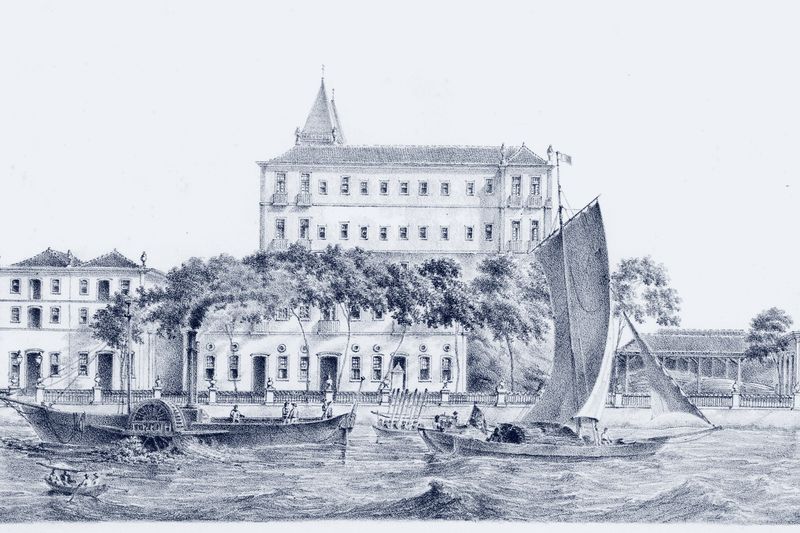
I am a hydrographer in time of peace, but in time of war I claim my standing as a combat officer, and I therefore hasten to request Your Excellency's permission to take the ship under my command to the port of Rio de Janeiro to complete her guns and munitions, and then sail for the River Plate to join the Division in operations.
- 1876Hydrographic OfficeImperial Decree 6,113
- 1891Maritime Chart Officereorganization
- 1908Navigation Superintendencyreorganization
- 1946Directorate of Hydrography and Navigationcurrent name of DHN
- 1998Navy Hydrographic Centercreated within DHN, activated in 1999
Sources Decreto nº 74.055, de 13/05/1974, art. 1º; CHM, Histórico
Milestones 9
1830s
Brazilian officers draw the first charts
From 1830 on, Navy officers begin surveying the coast themselves. Until then, navigation relied on Portuguese and French charts, notably those by Mouchez.
1840
The pharmacy moves into the hospital
Decree No. 58 attaches the Military Pharmacy to the Army and Navy Hospital.
1850 to 1867
Vital de Oliveira surveys the northeastern coast
In the 1850s and 1860s, Manoel Antônio Vital de Oliveira surveys the coast from Rio Grande do Norte to Alagoas, producing five charts and sailing directions. He is the patron of Brazilian hydrography.
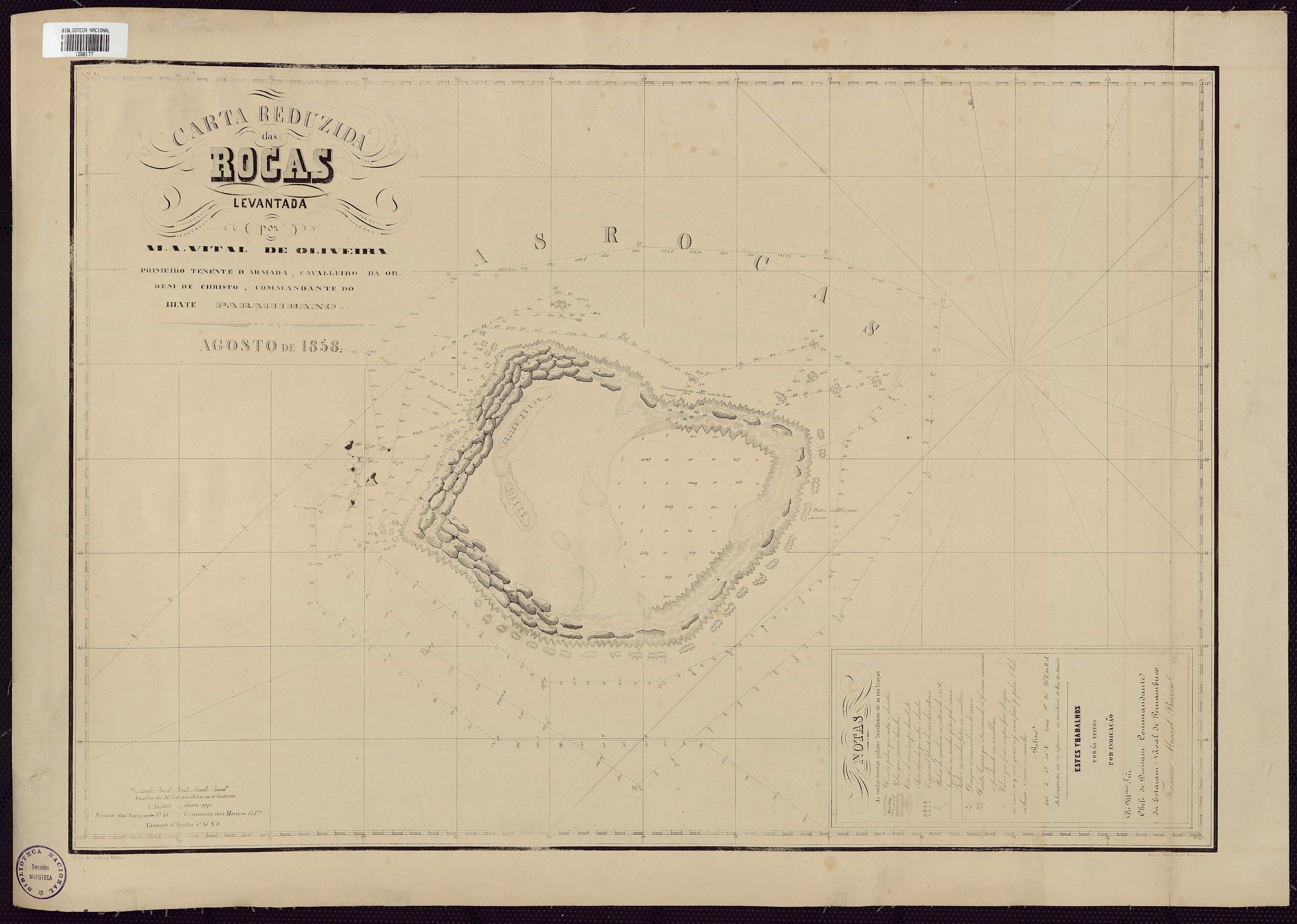
Chart of Rocas Atoll, surveyed by Manoel Antônio Vital de Oliveira in August 1858. National Digital Library of Chile.Manoel Antônio Vital de Oliveira (1829-1867), Biblioteca Nacional Digital do Chile. Public domain 1857
Hydrographic survey of Guanabara Bay
Serving as aide to the future Viscount of Lamare, young officer Antônio Luís von Hoonholtz, later Baron of Teffé, carries out one of the Navy's first hydrographic surveys.
1859
The Compendium of Hydrography is published
Hoonholtz publishes his Compendium of Hydrography, regarded as the first Portuguese-language work on the subject adopted by the Navy Academy.
1865 to 1866
Ironclads designed and built at the Arsenal
During the War of the Triple Alliance, Brazilian engineers such as Napoleão Level and Carlos Braconnot design and build armored warships at the Court Arsenal. The Tamandaré is among the first three.
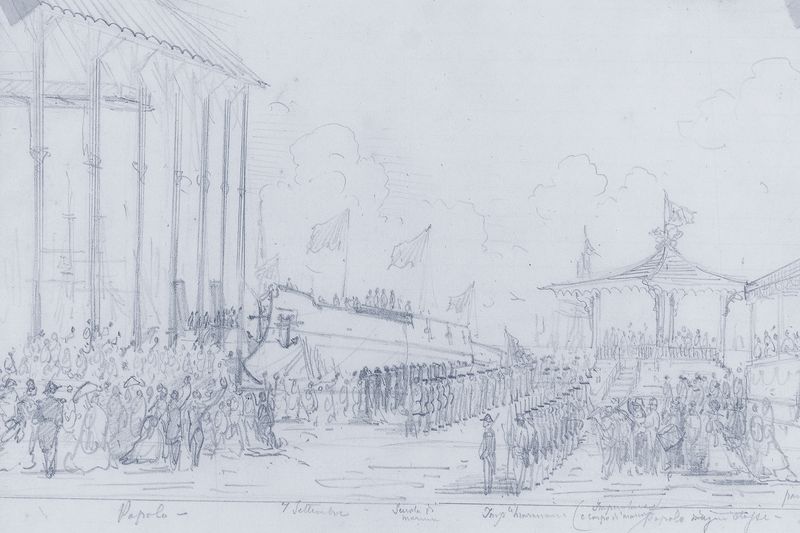
Launch of the ironclad Sete de Setembro at the Rio de Janeiro Navy Arsenal on 16 May 1874. Drawing by an unidentified artist, Brasiliana Iconográfica.Unidentified author, Brasiliana Iconográfica. Public domain processed image 1876
The Hydrographic Office is created
Decree No. 6,113 creates the Hydrographic Office to produce the general chart of Brazil's coasts, with the Baron of Teffé as its first director. It is the forerunner of the DHN and of today's CHM.
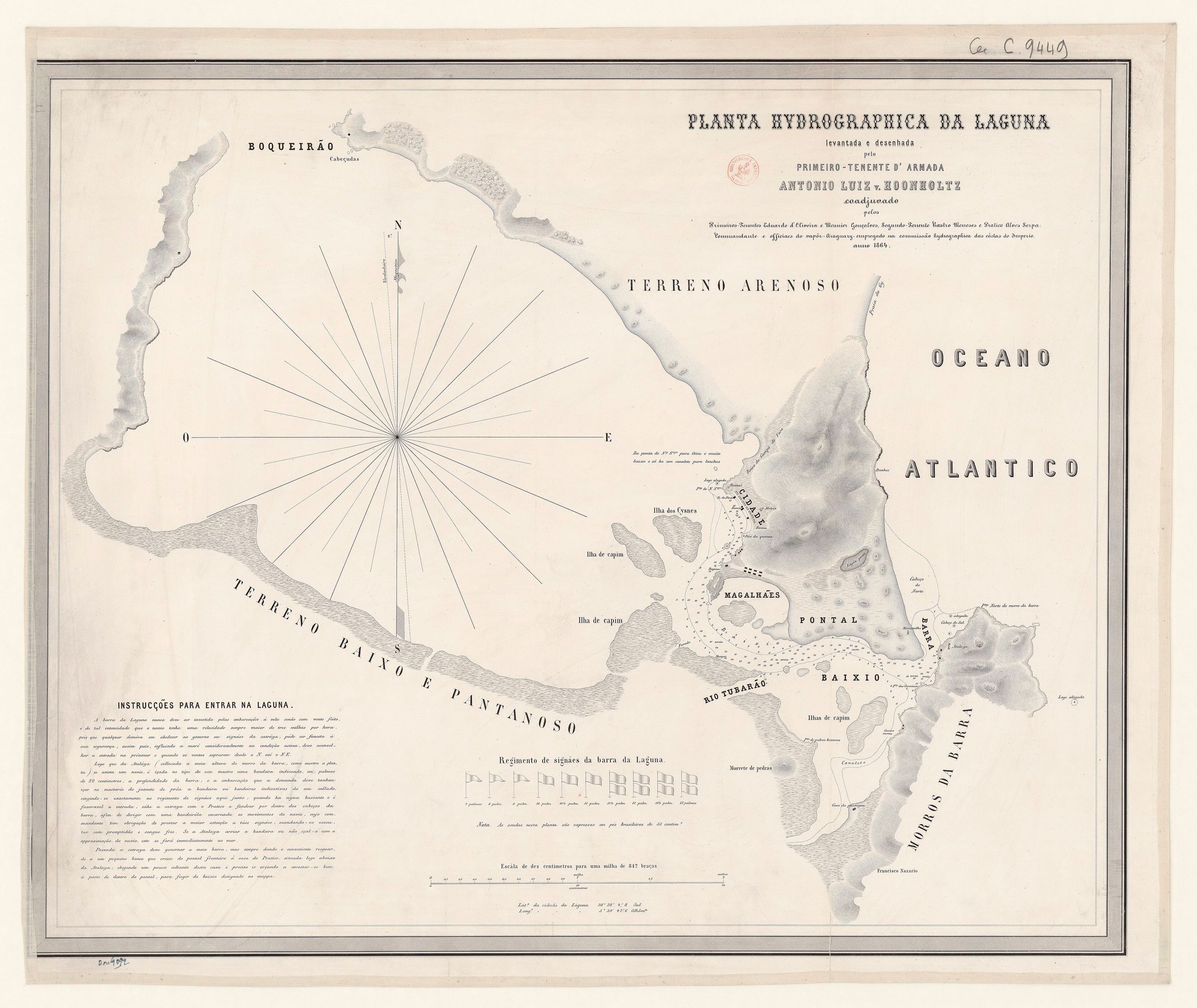
Hydrographic chart of Laguna, Santa Catarina, surveyed by Lieutenant Antonio Luiz von Hoonholtz, 1864. Bibliothèque nationale de France.Antonio Luiz von Hoonholtz (1837-1931), Bibliothèque nationale de France. Public domain 1882
The Navy observes the Transit of Venus
At the invitation of Luís Cruls of the Imperial Observatory, Teffé leads the Brazilian team on St. Thomas, in the Antilles, as part of a 14-nation effort to measure the solar parallax.
1888
The Central Meteorological Office is created
Decree No. 9,916 sets up within the Navy Ministry the Empire's center for meteorology and terrestrial physics, staffed by naval officers and issuing weather warnings to ports.
Source (1)
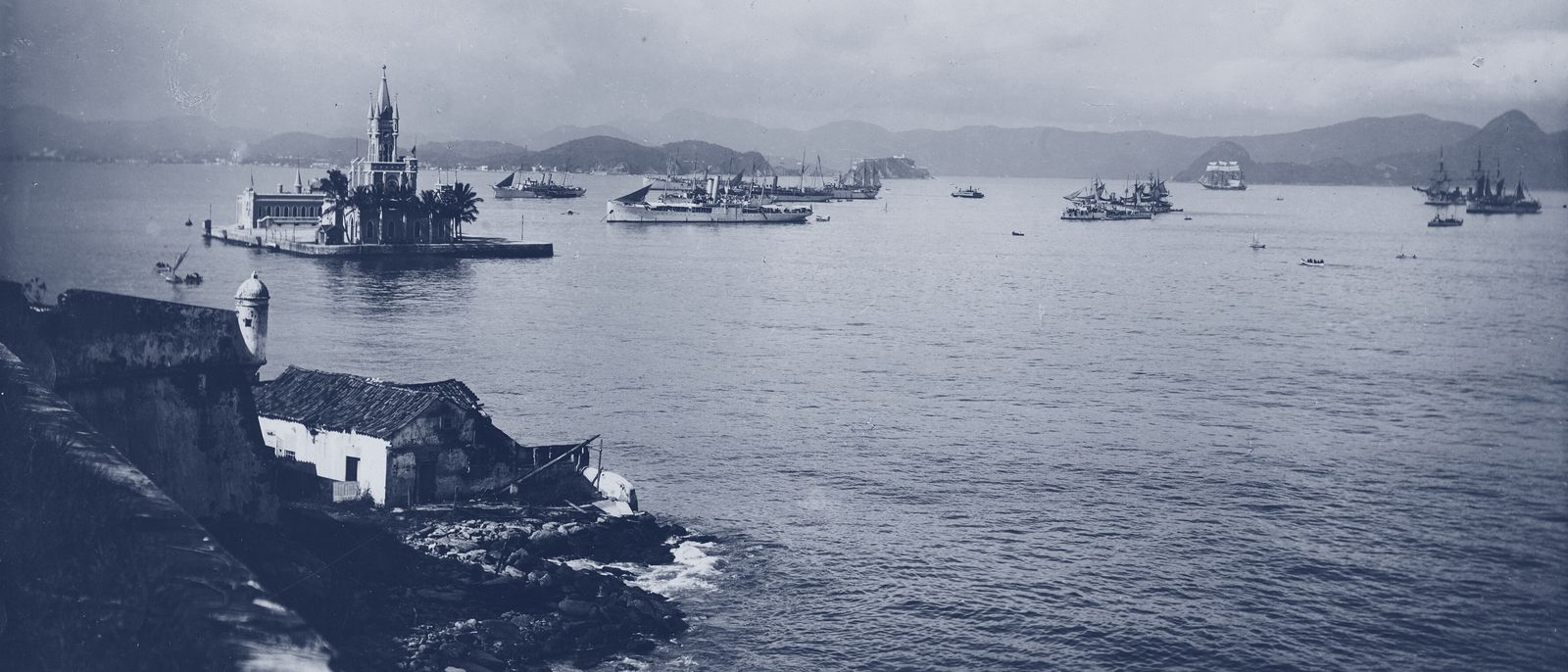
In the Showcase today
Institutes rooted in this era and what they offer now.
People of this era
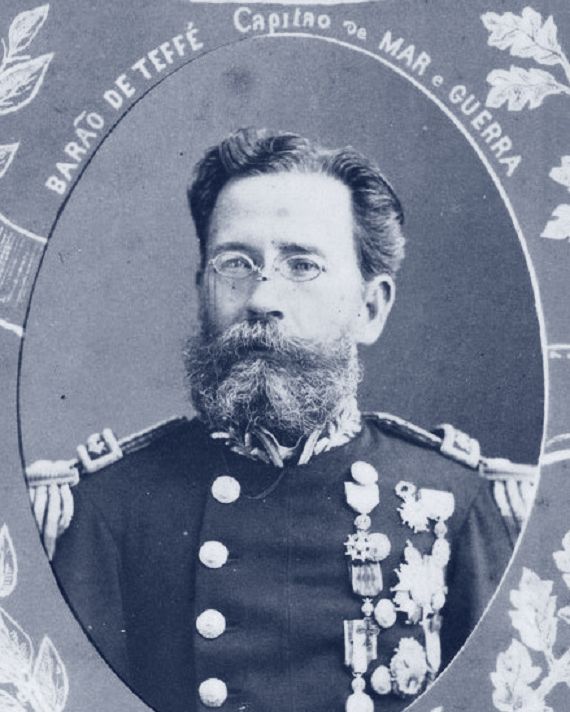
- 1829 to 1867Commander Vital de OliveiraHydrographyPatron HydrographyRead profile
- 1797 to 1868Surgeon General of the Navy Soares de MeirellesMedicine and naval healthPatron Navy Medical CorpsRead profile
- 1848 to 1906Rear Admiral (Naval Engineer) João Cândido BrazilNaval engineering and shipbuildingPatron Naval Engineers CorpsRead profile
Era 3 1889 to 1945
New technologies of the Republic
Radio, submarines and aircraft reach the Navy early, but its ships still arrive ready-made from abroad.
The Navy is an early adopter of the technologies changing warfare: wireless telegraphy in 1904, submarines in 1914 and, in 1916, the country's first military flying school. Education grows with the Higher Naval Course (1911) and the Naval War School (1914).
Ships, however, still come ready-made from foreign yards. The Arsenal is modernized on Cobras Island only around 1930. In the 1930s hydrography becomes an institution, Brazil prints its first nautical chart (1933) and the Naval Institute of Biology is created (1934).
The creation of the Air Ministry in 1941 takes away the Navy's air arm and closes the era.
Why it matters. It reveals the tension between adopting technology and mastering it, which drives the rest of this history.
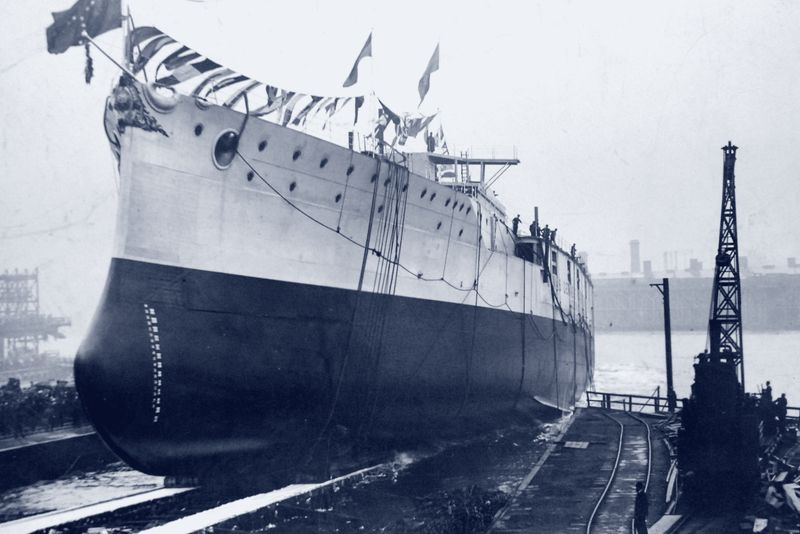
- 1916 to 1941Naval Aviation School and first air arm
- 1952 to 1965Navy Aeronautics Directorate
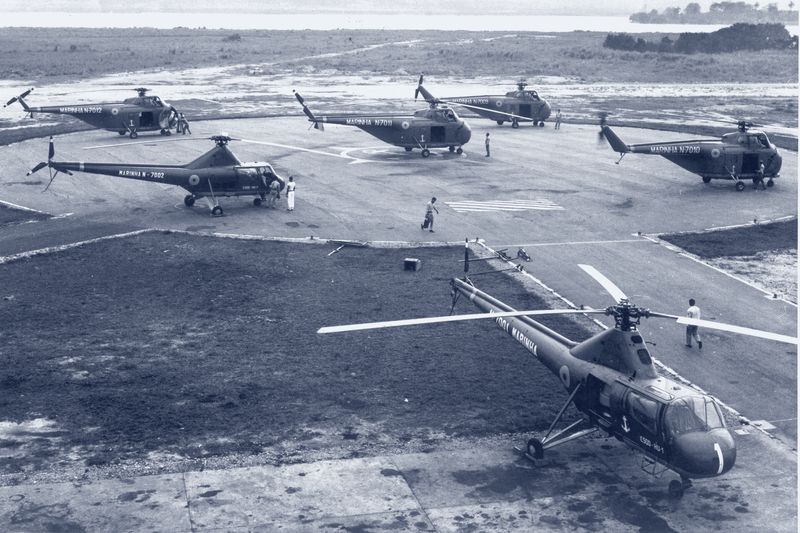
- 1965 to 1998Helicopters only, by decree
- 1998 to todayFixed wing returns
- Aircraft and helicopters
- Rotary wing only
- No air arm of its own (1941 to 1952)
Milestones 12
1891
Hydrography becomes the Maritime Chart Office
Decree No. 658 reorganizes the Hydrographic Office and renames it the Maritime Chart Office.
1904
The Navy tests wireless telegraphy
A commission tests two Telefunken sets at the Naval Battalion on Cobras Island. In 1905 the battleship Aquidabã becomes the first ship of the fleet fitted with the equipment.
1911
The Higher Naval Course is created
Decree No. 8,650 creates the Higher Naval Course at the Naval School, the forerunner of the Naval War College.
Source (1)
1914
The Submarine Flotilla is formed
Three small Foca-class submarines mark the beginning of the Brazilian Navy's submarine force.
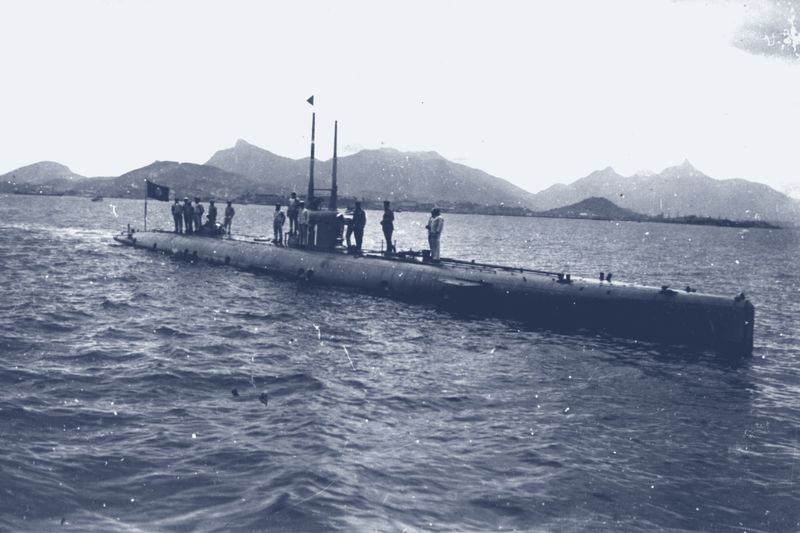
Submarine F1, of the Foca class, which opened the Submersibles Flotilla on 17 July 1914 and was decommissioned in 1933.Brazilian Navy (official Flickr mboficial). CC BY-SA 2.0 processed image 1915
The Navy Sports League is founded
The Navy Sports League is the origin of today's CEFAN, which takes its current name in 1973.
Source (1)
1916
Aviation and Submarine Schools are created
Decree No. 12,167 creates both schools. The aviation school, the country's first military flying school, starts with three Curtiss F flying boats.
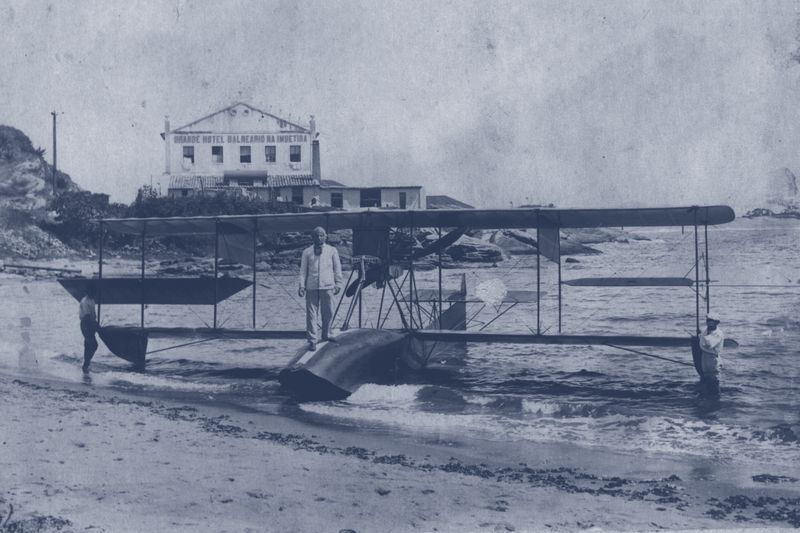
Lieutenant Schorcht and Lieutenant Commander Protógenes Guimarães with the seaplane in which they began the first air raid to Campos, Rio de Janeiro, on 4 January 1917.Brazilian Navy (official Flickr mboficial). CC BY-SA 2.0 processed image 1930
The new Arsenal opens on Cobras Island
Designed in 1920 and revised in 1926, the new Arsenal is in operation by 1930. Its Structures Shop was the largest covered industrial area in South America.
1933
The first nautical chart printed in Brazil
The Mangaratiba chart, covering Ilha Grande, is printed by a local press, still in rudimentary form. Hydrography becomes an institution in these years, and an offset press arrives in 1939.
In the Showcase today
Institutes rooted in this era and what they offer now.
People of this era
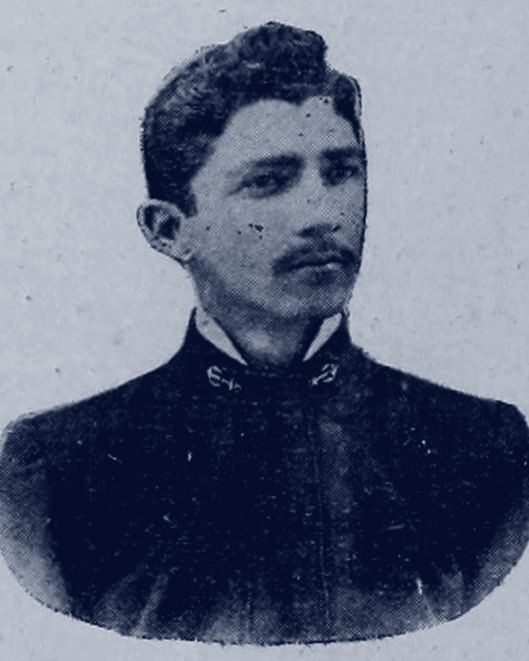
- 1876 to 1938Vice Admiral Protógenes GuimarãesNaval aviationPatron Naval AviationRead profile
- 1882 to 1941Vice Admiral Moraes RegoRadiotelegraphy and naval communicationsPatron Naval CommunicationsRead profile
- 1870 to 1929Vice Admiral Felinto PerrySubmarinesPatron Submarine ForceRead profile
Era 4 1946 to 1969
Science as state policy
The postwar years convince the Navy that it needs its own laboratory and a national science policy.
In 1947 Admiral Álvaro Alberto takes a proposal for an atomic program to the government, and he conceives the CNPq, created in 1951 with him as president. In 1954 he negotiates three German ultracentrifuges, whose shipment is blocked by the Allied occupation authorities.
In 1953 Admiral Paulo Nogueira Penido proposes a research laboratory. The cornerstone is laid in 1955 and IPqM is born in 1959, with marine biology and oceanography alongside weapons and electronics. Robert Oppenheimer visits in 1961.
In 1956 Paulo Moreira identifies the Cabo Frio upwelling as a source of food from the sea. The pharmacy becomes the Pharmaceutical Laboratory in 1958.
Why it matters. It produces the Navy's first R&D center and an explicit bridge between the Navy, national science and nuclear energy.
The export, in any form, of uranium and thorium and their compounds and ores is prohibited, except from government to government, after consultation with the competent bodies.
Milestones 12
1947
A national atomic program is approved
The National Security Council approves Admiral Álvaro Alberto's proposal, sent from New York, for a national atomic energy program.
1951
The National Research Council is created
Law No. 1,310 creates the CNPq, conceived and first chaired by Admiral Álvaro Alberto. The law bans exports of uranium and thorium except between governments.
1953
A Navy research laboratory is proposed
In Letter No. 1204, Director-General of Electronics Admiral Paulo Nogueira Penido proposes to the Navy Minister the creation of a research laboratory.
1954
Three ultracentrifuges are bought in Germany
In secret talks led by Álvaro Alberto, Brazil buys three ultracentrifuges in West Germany. The Allied occupation authorities, under US pressure, block their shipment.
1955
IPqM's cornerstone is laid
The cornerstone is laid at Ponta do Matoso, on Governador Island, with Álvaro Alberto present. The building is designed by architects Hélio Queiroz Duarte and Ernest Mange.
1956
Paulo Moreira points to the Cabo Frio upwelling
Lieutenant Commander Paulo Moreira identifies the Cabo Frio area, where cold, nutrient-rich water wells up, as a promising place to produce protein from the sea.
Source (1)
1958
The pharmacy becomes the Pharmaceutical Laboratory
Decree No. 44,898 restructures the former Military Pharmacy and names it the Navy Pharmaceutical Laboratory.
1959
The Navy Research Institute is created
Decree No. 46,426 creates IPqM with seven fields: weapons, marine biology, biochemistry, physical oceanography, electronics, chemistry and underwater acoustics.
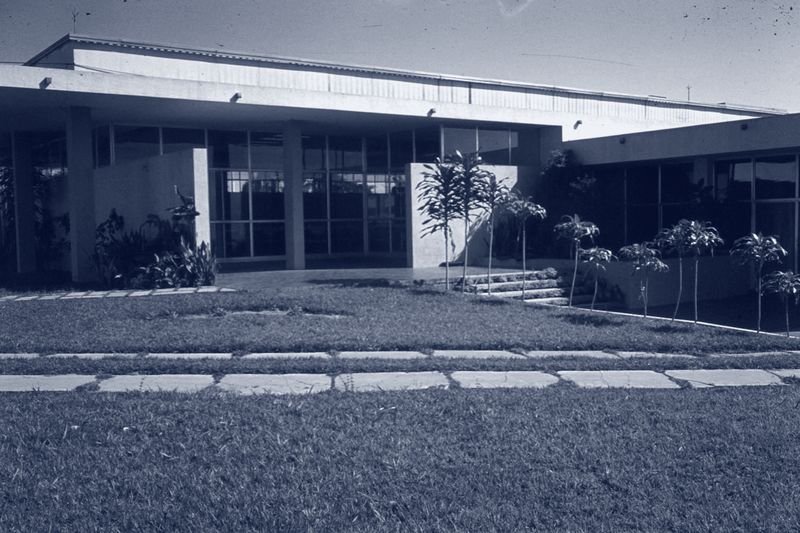
Building of the Navy Research Institute (IPqM), created in 1959 on Ilha do Governador, Rio de Janeiro. Undated colour slide, Dyrce Lacombe collection, Casa de Oswaldo Cruz.Unidentified author, Casa de Oswaldo Cruz (Fiocruz), coleção Dyrce Lacombe. CC BY-SA 4.0 processed image 1961
The aircraft carrier Minas Gerais arrives
The aircraft carrier Minas Gerais arrives, and Notice No. 1003 of June 5 creates the Naval Air Force.
Source (1)
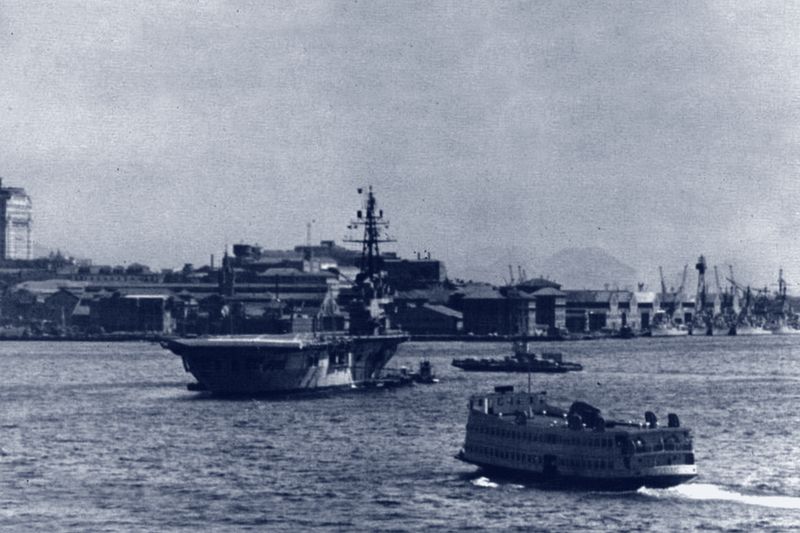
Light aircraft carrier Minas Gerais (A11) at anchor off Rio de Janeiro in 1968. U.S. Navy photo.U.S. Navy (cruise book do USS America). Public domain (US Government work) processed image 1961
Robert Oppenheimer visits IPqM
Physicist Robert Oppenheimer signs the institute's Book of Honor. Álvaro Alberto also records the visit.
In the Showcase today
Institutes rooted in this era and what they offer now.
Era 5 1970 to 1989
Frigates, computers and the sea
A digital frigate program pulls along a computer, a company and a research center. The same period creates most of today's institutes.
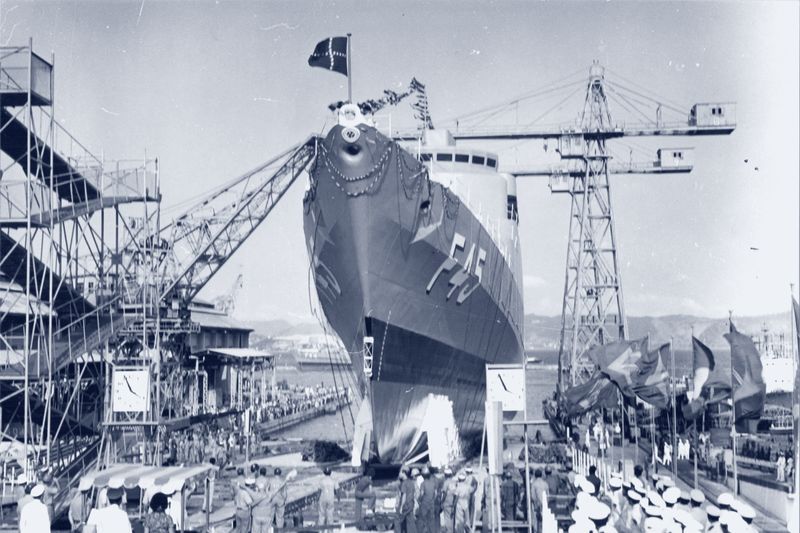
The Niterói frigates, the Navy's first ships with digital weapon and sensor systems, lead to three offshoots: the working group behind the G-10 computer and COBRA (1974), CASNAV (1975), created to evaluate them, and the building of two of them at the Rio Navy Arsenal. The Naval Engineering Directorate designs the Inhaúma corvettes.
The Navy Nuclear Program begins in 1979 within the autonomous program known as the parallel program. It gains COPESP in 1986, sees mastery of enrichment announced in 1987 and opens Aramar in 1988. The 1988 Constitution limits nuclear activity to peaceful purposes.
The Cabo Frio Project becomes INEM (1984), today's IEAPM. Brazil reaches Antarctica (1982 and 1984) and begins surveying its own continental shelf (1987).
Why it matters. This is the era of import substitution in sensitive technology, with the Navy as the customer that drives industry.
all nuclear activity within the national territory shall only be admitted for peaceful purposes and subject to the approval of the National Congress
- Computer1972G-10 prototypedeveloped by USP and PUC-Riobefore: Special Working Group, 1971, a Navy initiative with the Planning Secretariat
- Company1974COBRAComputadores e Sistemas Brasileiros, born from Navy demand, inherits the G-10
- Research center1975CASNAVcreated for the operational assessment of the frigates
Two of the six frigates, Independência and União, were built at the Rio de Janeiro Navy Arsenal between 1972 and 1980.
Sources Vaisburd, "Yes, o Brasil tem Cobra", COPPE/UFRJ, 1999; CASNAV, Histórico; Vogt, Revista Marítima Brasileira, 1º trim. 2015
- 01Mining and millingore becomes concentrate (yellowcake)
- 02Conversionconcentrate becomes uranium hexafluoride, a gas
- 03Enrichmentcascaded ultracentrifuges separate uranium-235; ABACC and IAEA safeguardsStep developed by the Navy
- 04Reconversionthe gas becomes uranium dioxide powder again
- 05Fuel elementpellets in grouped rods
- 06Reactorfission produces heat; in a submarine, propulsion. LABGENE, at Aramar, is the land-based prototypeStep developed by the Navy
- 07Back endspent fuel storage and waste management
- Natural uranium: about 0.7% uranium-235
- Low enrichment, used in power reactors: 3% to 5%
Sources CNEN, apostila "A Energia Nuclear e suas Aplicações"; INB, "O que é o enriquecimento"; Planalto, PROSUB, 27/03/2024
Coastline: Natural Earth. Station position: Wikidata. Illustrative, not for navigation. South polar stereographic (true-scale parallel 71° S, central meridian 58° W, WGS84); the inset uses the same projection.
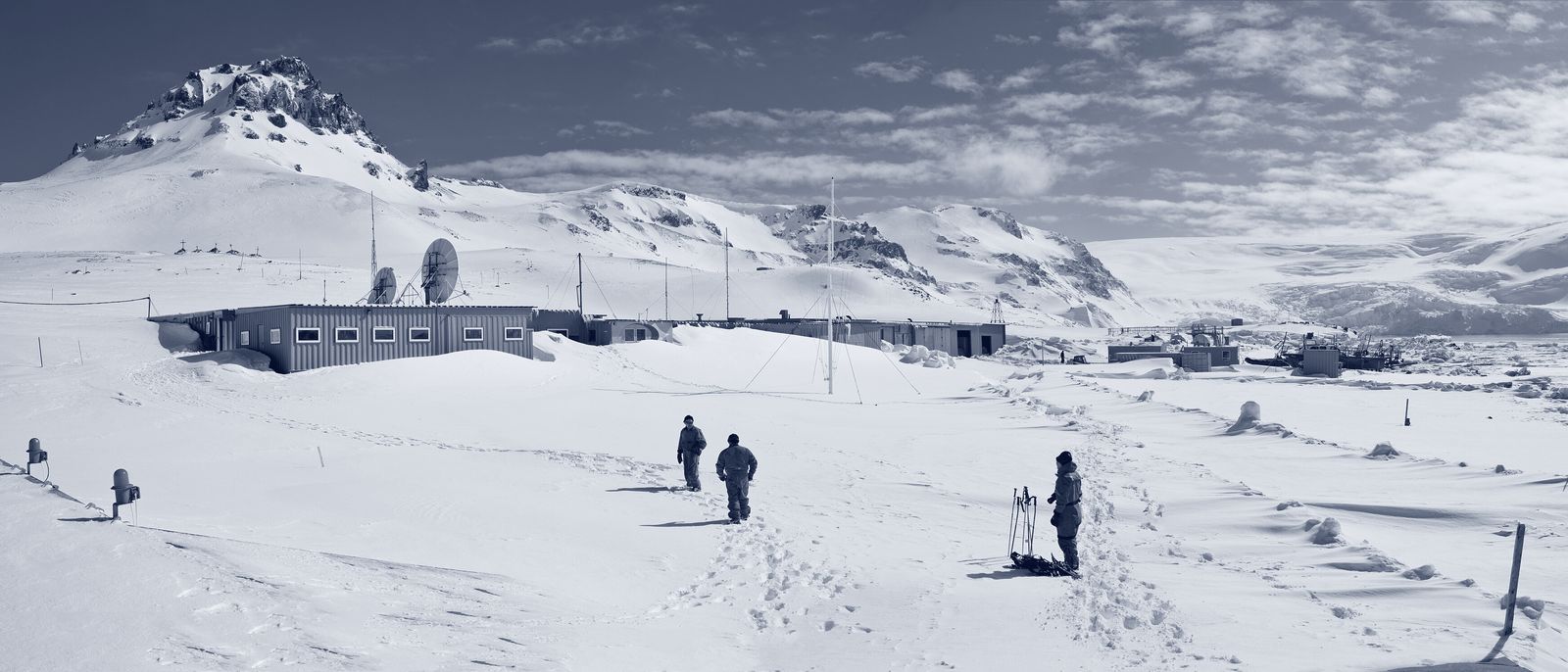
Sources Natural Earth, Admin 0 Countries 1:10m e 1:50m, Land 1:10m, Antarctic Ice Shelves 1:10m; Wikidata Q683143, Estação Antártica Comandante Ferraz, coordenada (P625); SECIRM, Estação Antártica Comandante Ferraz
Milestones 18
1971 to 1974
The Cabo Frio Project begins
Conceived by Paulo Moreira at IPqM, the project starts in 1971 and moves to Arraial do Cabo in 1974, with ice for fishermen, mariculture and the idea of a university of the sea.
1971
The Marine Corps technical center is created
The Marine Corps Special Repairs and Supplies Center is created and activated in 1972. In 2012 it becomes the Marine Corps Technology Center.
1972 to 1980
Niterói frigates: the first digital ships
Designed by Vosper Thornycroft, four frigates are built in England and two, Independência and União, at the Rio Navy Arsenal. They are the Navy's first ships with digital weapon and sensor systems.
1974
COBRA is born from the Navy's demand
Computadores e Sistemas Brasileiros (COBRA) is founded and takes over the G-10. The working group is dissolved in 1976, and its successor, the G-11, comes out in 1978.
1978 to 1994
Inhaúma corvettes: designed in Brazil
The Naval Engineering Directorate handles concept and design; the Rio Navy Arsenal details and builds them. They are the first combat ships designed and built in Brazil since the Republic began.
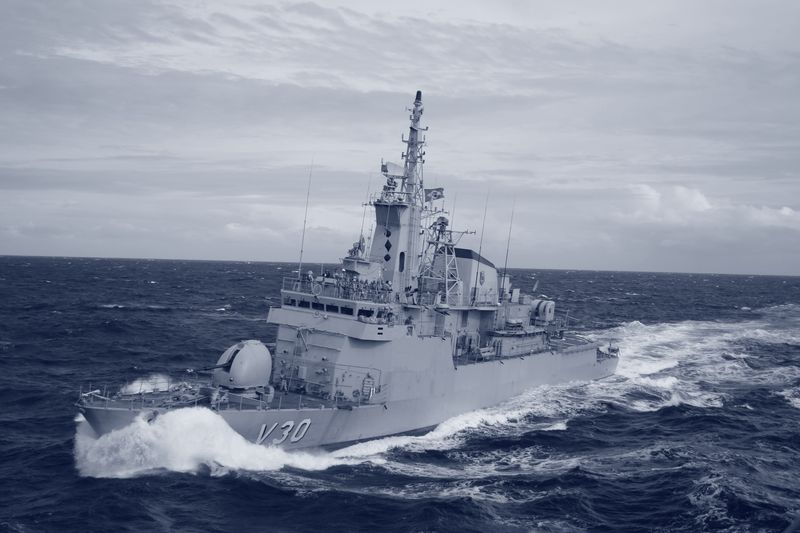
Corvette Inhaúma (V30), first of the class conceived by the Directorate of Naval Engineering and built at the Rio de Janeiro Navy Arsenal. Photo from 2005.Brazilian Navy (official Flickr mboficial). CC BY-SA 2.0 processed image 1979
The Navy Nuclear Program begins
The Navy starts its program to master the nuclear fuel cycle and develop a propulsion plant. It is part of Brazil's autonomous program, known as the parallel program, secret and outside safeguards.
1982
First enrichment with Brazilian centrifuges
The first uranium enrichment experiment using ultracentrifuges of Brazilian design, developed under the Navy program, is carried out.
Source (1)
1982
IKL-1400 submarines are ordered
The Tupi is built in Kiel, Germany, and the other three of the class at the Rio Navy Arsenal between 1986 and 1999. The second, Tamoio, is the first submarine built in Brazil.
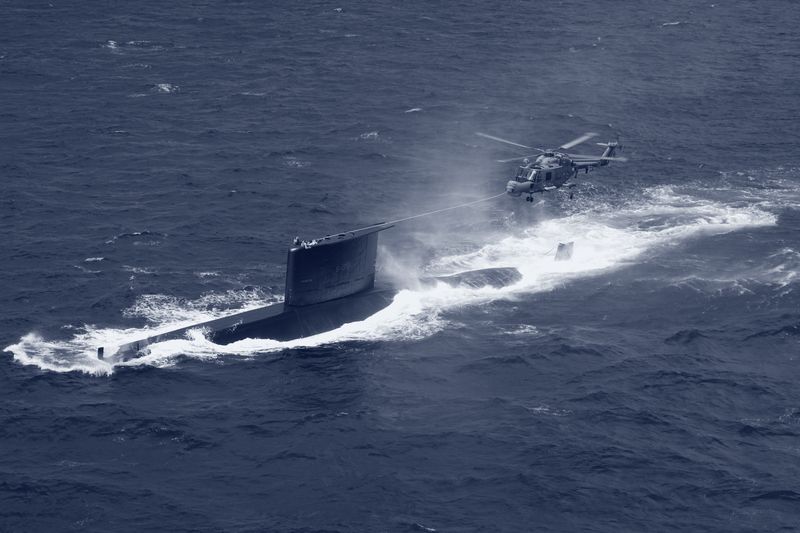
Submarine Tamoio (S31), the first built in Brazil, at the Rio de Janeiro Navy Arsenal. Photo from 2006.Brazilian Navy (official Flickr mboficial). CC BY-SA 2.0 processed image 1982
The Brazilian Antarctic Program is created
Decree No. 86,830 assigns the Antarctic Program to CIRM, the interministerial sea resources commission created in 1974. In December, two research ships sail on the first expedition.
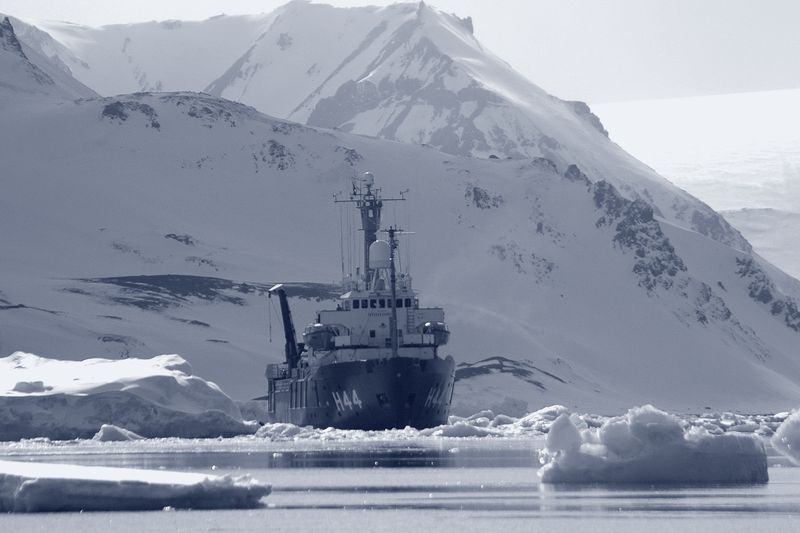
Oceanographic support ship Ary Rongel (H44) in Antarctic waters, 4 January 2004.Brazilian Navy (official Flickr mboficial). CC BY-SA 2.0 processed image 1984
Comandante Ferraz Antarctic Station opens
On Keller Peninsula, King George Island, the station opens with eight modules, about 150 m² and a 12-person base team for 32 days.
1984
The National Institute of Sea Studies is created
INEM takes over the Cabo Frio Project and IPqM's marine biology work. In 1985 it is named after Paulo Moreira, becoming today's IEAPM.
1986
COPESP, forerunner of CTMSP, is created
Decree No. 93,439 creates the Special Projects Coordination Office in São Paulo to obtain systems with special characteristics for the Navy. Since 1995 it has been called CTMSP.
Sources (2)
1987
The continental shelf survey begins
The survey ship Almirante Câmara carries out the first LEPLAC mission. In 1989, Decree No. 98,145 approves the plan that underpins Brazil's later claim at the UN.
1987
Mastery of enrichment is announced
The President announces that Brazil has mastered uranium enrichment, achieved within the autonomous program known as the parallel program.
1988
The Biomedical Research Institute is created
Under Decree No. 95,869, Marcílio Dias Naval Hospital takes over the Navy's medical research through the Biomedical Research Institute.
Source (1)
1988
Aramar Experimental Center opens
In Iperó, São Paulo State, Aramar becomes home to the Navy nuclear program's facilities, including the Admiral Álvaro Alberto Enrichment Unit.
Sources (2)
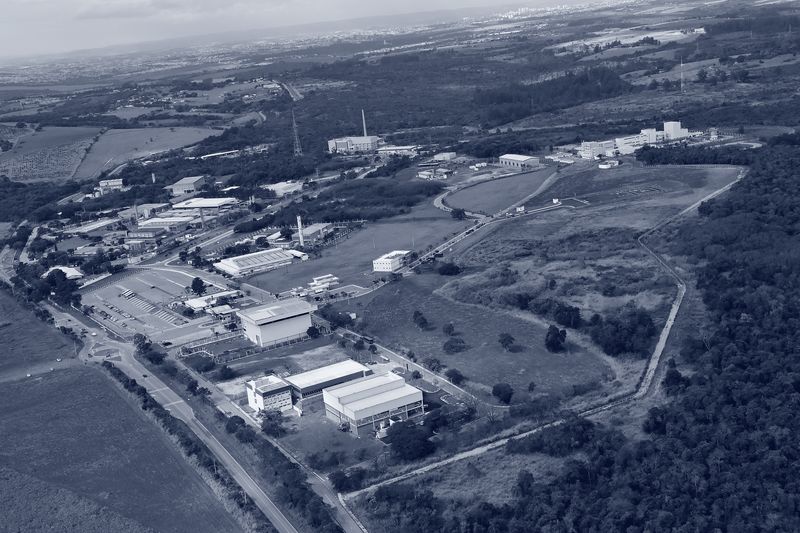
Aerial view of the Aramar Experimental Center in Iperó, São Paulo, during the IAEA Director General's visit on 17 July 2021. IAEA Imagebank.IAEA Imagebank (Flickr). CC BY 2.0 processed image
In the Showcase today
Institutes rooted in this era and what they offer now.
- CASNAVNaval Systems Analysis Center6 technologies in the portfolio
- IEAPMAdmiral Paulo Moreira Institute of Marine Studies3 technologies in the portfolio
- CTMSPNavy Technology Center in São Paulo4 technologies in the portfolio
- CTecCFNMarine Corps Technology Center
- HNMD/IPBMarcílio Dias Naval Hospital / Biomedical Research Institute2 technologies in the portfolio
Era 6 1990 to 2007
The Blue Amazon
The focus of naval science shifts from the ship to the maritime territory.
Law 8,617 (1993) and the entry into force of the Law of the Sea Convention for Brazil (1994) give the maritime territory a legal basis. In 2004 the country submits its continental shelf outer limit to the UN, and the Navy Commander coins the term Blue Amazon.
CASNAV starts providing S&T services (1997), fixed-wing aviation returns (1998), the Hydrographic Center is created (1998) and a research station begins operating on the São Pedro and São Paulo Archipelago.
Brazil creates ABACC with Argentina (1991) and joins the NPT (1998). On a tight budget, the nuclear program brings its centrifuges to industry at Resende (2006) and is revived in 2007.
Why it matters. It gives this history its central argument: ocean science is sovereignty, which is why hydrography, ocean data and maritime surveillance are S&T subjects.
- Exclusive Economic Zone (up to 200 nautical miles) 3,677,664 km²
- Southern Region: shelf beyond 200 miles with UN recommendation (2019) about 170,000 km²
- Equatorial Margin: shelf beyond 200 miles with UN recommendation (2025) about 360,000 km²Drawn from the limit submitted in 2017; the limit approved in 2025 is not yet available as open data and may differ slightly.
- Eastern and Southern Margins: area claimed beyond 200 miles, under UN review about 1,500,000 km²
EEZ and continental shelf: Flanders Marine Institute, Marine Regions, CC BY 4.0. Coastline: Natural Earth. Illustrative, not for navigation. Albers equal-area conic (standard parallels 2° S and 28° S, central meridian 48° W, WGS84); preserves areas.
Sources Natural Earth, Admin 0 Countries 1:10m e 1:50m, Land 1:10m, Antarctic Ice Shelves 1:10m; Marine Regions, World EEZ v12 (MRGID 8464 e 8381); SECIRM, LEPLAC (áreas oficiais anunciadas)
Milestones 13
1991
Brazil and Argentina create ABACC
The two countries sign an agreement on the exclusively peaceful use of nuclear energy and create ABACC. In December they sign the Quadripartite Agreement with the IAEA in Vienna.
1993
A law defines Brazil's maritime zones
Law No. 8,617 defines Brazil's territorial sea, exclusive economic zone and continental shelf in line with the UN Convention on the Law of the Sea.
Sources (2)
1994
The Law of the Sea Convention enters into force for Brazil
The UN Convention on the Law of the Sea enters into force for Brazil, providing the legal basis for its claim to the continental shelf beyond 200 nautical miles.
Source (1)
1998
A research station on the São Pedro and São Paulo Archipelago
The first research station on the São Pedro and São Paulo Archipelago, in the middle of the Atlantic, begins operating. It is replaced by a new one in 2008.
1998
Naval Aviation returns to fixed-wing aircraft
Decree No. 2,538 returns fixed-wing aircraft to the Navy, which had been limited to helicopters since 1965. The fourth phase of Naval Aviation begins.
Source (1)
1998
Brazil joins the NPT
Brazil deposits its instrument of accession to the Treaty on the Non-Proliferation of Nuclear Weapons. The 1988 Constitution already limited nuclear activity to peaceful purposes.
1998
The Navy Hydrographic Center is created
Ministerial Order No. 360 creates the CHM, which is activated within the DHN on December 27, 1999.
2004
The term Blue Amazon is coined
In the article “The other Amazon”, in Folha de S.Paulo, the Navy Commander coins the term Blue Amazon for the waters under Brazilian jurisdiction.
2004
Brazil submits its shelf limit to the UN
Brazil submits its outer limit proposal to the Commission on the Limits of the Continental Shelf: 960,000 km² beyond 200 nautical miles, based on LEPLAC surveys.
Source (1)
2006
Navy centrifuges reach industry
INB opens in Resende, Rio de Janeiro State, the first industrial cascade of ultracentrifuges developed by CTMSP with IPEN. Work on the plant had begun in 2000.
2007
The UN asks for part of the claim to be revised
The Commission disagrees with about 190,000 km², or 20% of the area claimed. Brazil decides to prepare a revised submission backed by new surveys.
Source (1)
2007
The government revives the Nuclear Program
Visiting Aramar and the LABGENE prototype plant, the President announces funding to revive the program after years of sharply reduced budgets.
In the Showcase today
Institutes rooted in this era and what they offer now.
Era 7 2008 to 2026
An S&T system and industrial sovereignty
From three isolated institutes to a system of 18, as submarines, missiles and frigates come to be built in Brazil.
The Navy S&T Secretariat is created in 2008 with three institutes, becomes a sectoral directorate in 2012 and DGDNTM in 2016, taking over PROSUB and the Nuclear Program. NIT-MB (2009), AMAZUL (2012) and CTMRJ (2016) follow. By 2026 the system has 18 institutions.
The agreement with France (2008) creates PROSUB: Riachuelo is launched in 2018 and all four conventional submarines are afloat by 2025. The nuclear-powered submarine is in detailed design. MANSUP has flown since 2018, and the frigate Tamandaré is commissioned in 2026.
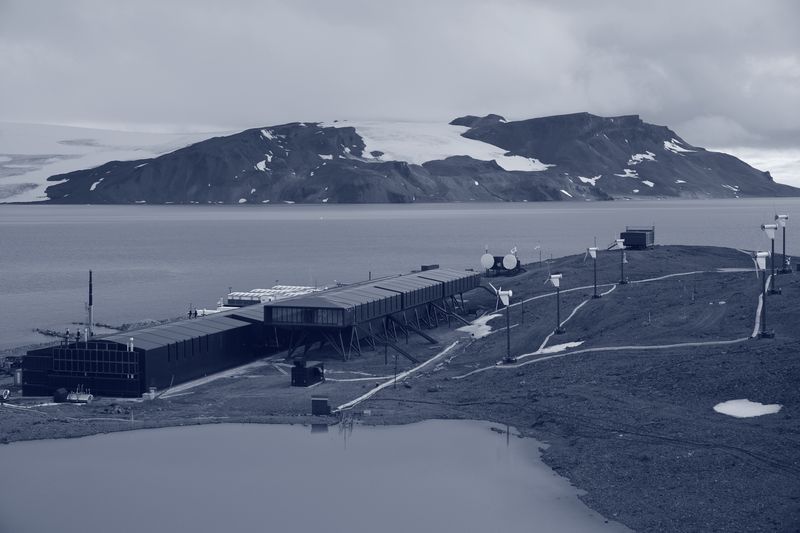
The UN approves the extended shelf of the Southern Region (2019) and of the Equatorial Margin (2025), and the new Ferraz Station opens in 2020.
Why it matters. This is the era in which this showcase exists: intellectual property, technology transfer and open innovation become part of the mission.
The submarine will be conventionally armed and will use low-enriched uranium. It does not pose proliferation risk.
- 1782ENRoyal Academy of Midshipmen (Lisbon; in Rio from 1808)
- 1808LFMMilitary Apothecary
- 1808DPHDMthe Academy's collection, kept by the Directorate
- 1876CHMHydrographic Office
- 1911EGNHigher Naval Course
- 1915CEFANNavy Sports League
- 1934HNMD/IPBNaval Institute of Biology
- 1959IPqMIPqM founded (proposed in 1953)
- 1971IEAPMCabo Frio Project (1956 expedition)
- 1971CTecCFNMarine Corps Special Repair and Supply Center
- 1975CASNAVDecree 75,335
- 1979CTMSPNavy Nuclear Program (COPESP, 1986)
- 2008DGDNTMNavy Secretariat for Science, Technology and Innovation
- 2012AMAZULLaw 12,706
- 2016CTMRJOrdinance 308/MB
OCM, DDNM and CPSN: date of origin not yet confirmed in a public source.
Recognized ICTs
Sources DGDNTM, Sistema de CT&I da Marinha; Dall'Agnol et al., Revista da EGN, v. 22, n. 2, 2016; Introdução à História Marítima Brasileira, DPHDM, 2025
- announced
- forecast
- 2008 delivery in the original plan: 2025. Kassenova, "Brazil's Nuclear Kaleidoscope", Carnegie, 2014
- 2020 submarine forecast, December 2020: 2033. Agência Brasil, 11/12/2020
- 2026 launch forecast, March 2026: 2037. BBC News Brasil, 31/03/2026
Milestones 22
2008
The Navy S&T Secretariat is created
Order No. 115/MB creates the Navy S&T Secretariat with three institutes: CASNAV, IEAPM and IPqM. It is the start of the system that brings together 18 Navy S&T institutions in 2026.
Source (1)
2008
Agreement with France creates PROSUB
Days after the National Defense Strategy adopts the nuclear-powered submarine project, Brazil and France sign an agreement for conventional submarines, a nuclear one and the Itaguaí complex.
2009
The Navy Technology Innovation Office is created
NIT-MB is set up to comply with the Innovation Law. The Navy's first intellectual property course, held in October and November, has more than 50 students.
2009
The Blue Amazon Management System is proposed
The Navy proposes SisGAAz. Halted in 2015 for lack of funds, it gets a pilot project built on Project Scua, developed by IPqM and tested in 2017.
2012
Fire destroys Ferraz Station
Fire destroys 70% of the Antarctic station and two service members die. A new station would open on the same site in 2020.
2012
AMAZUL is authorized
Law No. 12,706 authorizes Amazônia Azul Tecnologias de Defesa, a state-owned company spun off from EMGEPRON with the assets of the Navy Nuclear Program.
Source (1)
2016
The Navy Technology Center in Rio is created
Order No. 308/MB creates CTMRJ, activated in April 2017, which brings CASNAV, IEAPM and IPqM under one command.
Source (1)
2016
The S&T Secretariat becomes DGDNTM
Decree No. 8,900 turns the S&T Secretariat, a sectoral directorate since 2012, into DGDNTM, which takes over PROSUB and the Nuclear Program.
Source (1)
2018
First MANSUP launch
The corvette Barroso fires the first prototype of Brazil's anti-ship missile, a project started in 2008 with Omnisys, Fundação Ezute and SIATT. Further launches follow in 2019, 2022 and 2023.
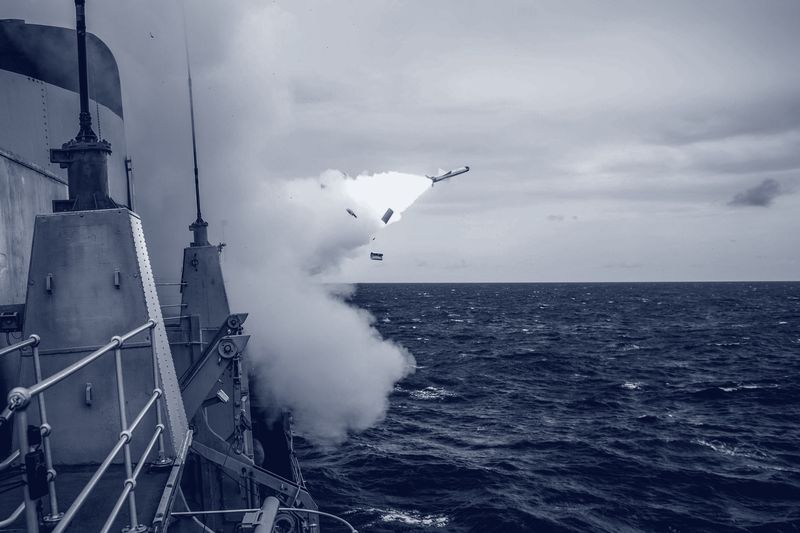
Launch of the national surface anti-ship missile MANSUP from the frigate Constituição in 2022, at the start of its qualification phase.Brazilian Navy (official Flickr mboficial). CC BY-SA 2.0 processed image 2018
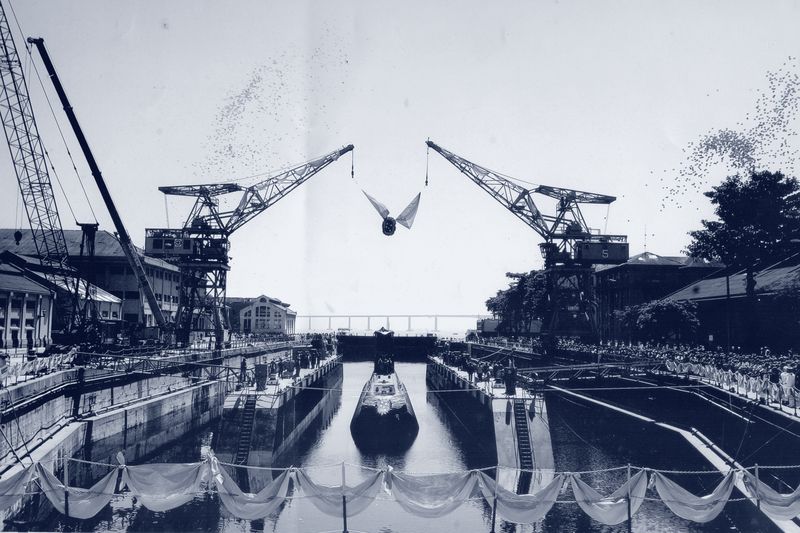
The submarine Riachuelo is launched
PROSUB's first submarine is launched at Itaguaí. Building in Brazil, with technology transfer, is at the core of the program.
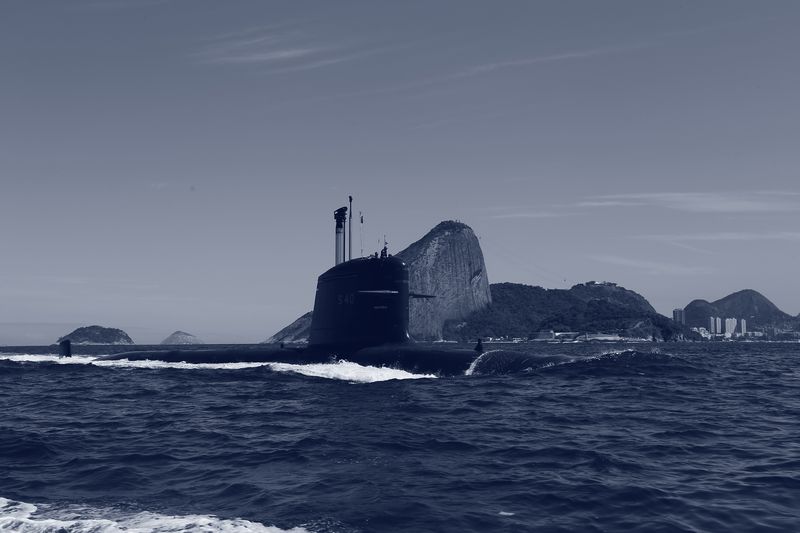
Submarine Riachuelo (S40), the first of the PROSUB programme, at the entrance to Guanabara Bay on 6 September 2022, the year she was commissioned.Brazilian Navy (official Flickr mboficial). CC BY-SA 2.0 processed image 2019
UN approves the Southern Region shelf
The Commission approves the southern margin, adding about 170,000 km² beyond 200 nautical miles to Brazil's continental shelf.
Source (1)
2020
The new Ferraz Station opens
On the site of the old one, the new station opens with 17 laboratories after modular pre-assembly in China. During OPERANTAR XLIV (2025-2026) it hosts 185 researchers and 26 projects.
2020
The submarine Humaitá is launched
PROSUB's second submarine is launched and joins the operational fleet in January 2024. At the launch, the published target for the nuclear submarine was 2033.
2021
CASNAV turns boats into uncrewed vehicles
CASNAV begins converting conventional boats into remotely operated surface vehicles. The technology is offered in this showcase as PRISMA.
In the Showcase today PRISMA
Source (1)
2022
Riachuelo enters service
Riachuelo is commissioned into the operational fleet, PROSUB's first delivery.
2024
Nuclear submarine in detailed design
The Navy reports that the conventionally armed nuclear submarine Álvaro Alberto is in detailed design and that construction of the hull qualification section has begun. Only its propulsion is nuclear.
2024
Naval heritage becomes an S&T institution
Order No. 233/EMA recognizes DPHDM as an S&T institution in archaeology, archival science, library science, museology and history.
Source (1)
2025
UN approves the Equatorial Margin
About 360,000 km² are added to the continental shelf, with the decision published on March 26. The Eastern and Southern margins remain under review.
Source (1)
2025
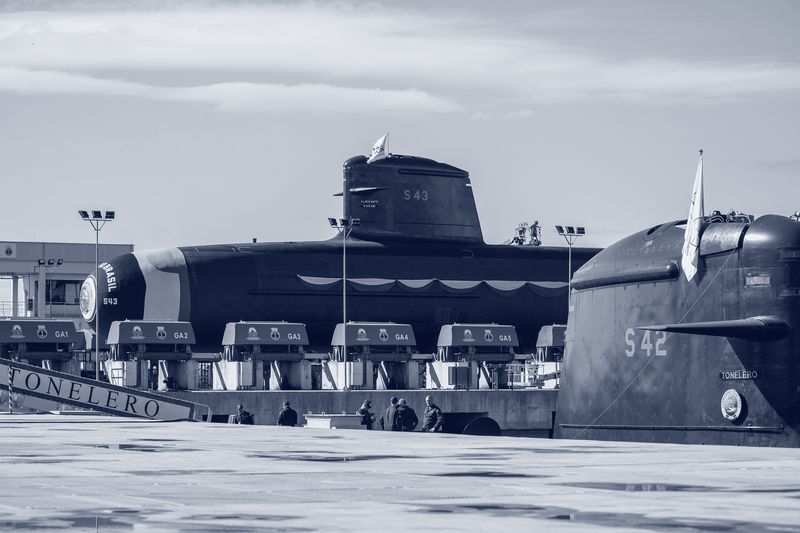
Tonelero delivered and Almirante Karam launched
At Itaguaí, Tonelero is commissioned and Almirante Karam, the last of PROSUB's four conventional submarines, is launched. In 2026 it completes its static dive test.
2026
The frigate Tamandaré is commissioned
Launched at Itajaí in 2024, the frigate joins the fleet. The program, run by the Águas Azuis consortium (TKMS, Embraer and Atech), involves about 8,000 workers and over 1,000 companies.
2026
The nuclear submarine at the NPT Review Conference
Brazil states that the submarine will be conventionally armed and use low-enriched uranium, and that it has consulted the IAEA and ABACC since 2022 on special verification procedures.
2026
MANSUP maximum-range test
In the fifth phase of qualification tests, the frigate Defensora fires the missile about 300 km off Cabo Frio.
In the Showcase today
Institutes rooted in this era and what they offer now.
- DGDNTMDirectorate-General for Nuclear and Technological Development of the Navy
- CTMRJNavy Technology Center in Rio de Janeiro1 technology in the portfolio
- AMAZULAmazônia Azul Tecnologias de Defesa S.A.
- DDNMNavy Nuclear Development Directorate
- CPSNNaval Systems Design Center
- CEFANAdmiral Adalberto Nunes Physical Education Center1 technology in the portfolio
- DPHDMNavy Directorate of Historical Heritage and Documentation
- ENNaval Academy
02 / People
The people behind this history
Profiles of deceased people with documented public careers. Official Navy patrons carry the patron seal. Living people have no profile.
- Surgeon General of the Navy Soares de MeirellesPatron
- Commander Vital de OliveiraPatron
- Rear Admiral (Naval Engineer) João Cândido BrazilPatron
- Vice Admiral Felinto PerryPatron
- Vice Admiral Protógenes GuimarãesPatron
- Vice Admiral Moraes RegoPatron
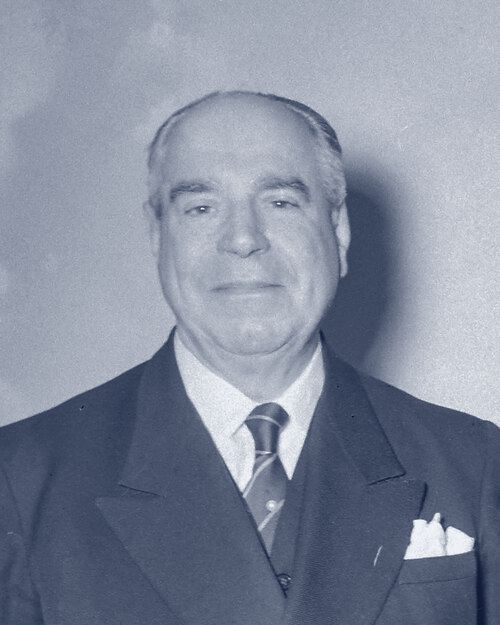
- Vice Admiral Paulo Moreira
- Commander Comandante Ferraz
Each bar runs from birth to death, on the same scale as the year ruler.
03 / Sources and collections
Where each piece of information comes from
Every statement on this page has a public source. Images come from openly licensed or public domain collections and were processed for the site; full credits are below and on the institutional page.
Quote labels: Document (read in the primary source), Record (reliable secondary source), Attributed (circulates without a located primary source).
Documents and bibliography 110
- "Ativação do Centro de Instrução e Adestramento Almirante Radler de Aquino (CIAARA)". Anais Hidrográficos, LXXVII, p. 213-215
- "Evolução da Força de Submarinos". Revista do Clube Naval
- "O Navio de Pesquisa Hidroceanográfico Vital de Oliveira". Revista Marítima Brasileira
- "Vice-Admiral de Aquino". Journal of Navigation, v. 7, n. 2, abr. 1954, p. 135
- ABACC, About ABACC
- Academia Nacional de Medicina, "Joaquim Candido Soares de Meirelles"
- Agência Brasil, 11/12/2020
- Agência Marinha de Notícias, 31/10/2024, avanços do submarino nuclear Álvaro Alberto
- Agência Marinha de Notícias, Estação Antártica Comandante Ferraz completa 41 anos
- Agência Marinha de Notícias, Fragata Tamandaré chega pela primeira vez ao Rio de Janeiro
- Agência Marinha de Notícias, Fragata Tamandaré é incorporada à Esquadra
- Agência Marinha de Notícias, L. Guimarães, A retórica e o cofre, 14/10/2025
- Agência Marinha de Notícias, MANSUP avança em processo de qualificação
- Agência Marinha de Notícias, Marinha inicia construção da quarta fragata da classe Tamandaré
- Agência Marinha de Notícias, Marinha lança ao mar o Almirante Karam e entrega o Tonelero, 26/11/2025
- Agência Marinha de Notícias, OPERANTAR XLIV reforça pesquisa científica
- Agência Marinha de Notícias, primeira atracação de submarino da classe Riachuelo em Mocanguê, 04/04/2024
- Agência Marinha de Notícias, Submarino Almirante Karam conclui imersão estática, 29/09/2026
- AIEA, GOV/INF/2024/13, 15/11/2024
- Arsenal de Marinha do Rio de Janeiro, Histórico
- BBC News Brasil, 31/03/2026
- Bohrer, A DHN retratada pela filatelia, Revista do Clube Naval nº 415
- BRAGA, C. C. "28 de Março, Dia das Comunicações Navais: Vice-Almirante Tácito Reis de Moraes Rego, Patrono das Comunicações Navais". Revista Marítima Brasileira, 1º trim. 2014
- Braga, Projeto piloto do SisGAAz, parte II, RMB, 2º trim. 2021
- CASNAV, Histórico
- CEFAN, Histórico
- Centro de Auxílios à Navegação Almirante Moraes Rego, heráldica (captura de 27/01/2025 no Internet Archive)
- CGCFN, Carta de Serviços ao Usuário do CTecCFN
- CHM, Histórico
- CNEN, apostila "A Energia Nuclear e suas Aplicações"
- CNPq, O Almirante
- Comando da Força Aeronaval, Histórico
- Constituição da República Federativa do Brasil de 1988
- CPDOC/FGV, DHBB, verbete "Álvaro Alberto da Mota e Silva"
- CTMRJ, "Marinha do Brasil promove Centenário de nascimento do Vice-Almirante Paulo Moreira" (captura de 16/04/2021 no Internet Archive)
- CTMRJ, Histórico
- CTMSP, Enriquecimento
- CTMSP, Programa Nuclear da Marinha
- CTMSP, Quem somos
- Câmara dos Deputados, Relações Exteriores aprova acordo sobre submarinos com a França
- Dall'Agnol et al., Revista da EGN, v. 22, n. 2, 2016
- Declaração do Brasil, Comitê Principal II, XI Conferência de Exame do TNP, 05/05/2026
- Decreto nº 1.065, de 24/02/1994 (Acordo Quadripartite)
- Decreto nº 12.167, de 23/08/1916
- Decreto nº 2.864, de 07/12/1998 (TNP)
- Decreto nº 6.113, de 2 de fevereiro de 1876
- Decreto nº 6.703, de 18/12/2008 (Estratégia Nacional de Defesa)
- Decreto nº 74.055, de 13/05/1974, art. 1º
- Decreto nº 77.070, de 21 de janeiro de 1976
- Decreto nº 86.830, de 12/01/1982
- Decreto nº 9.916, de 04/04/1888
- Decreto nº 91.124, de 13 de março de 1985
- Decreto nº 93.439, de 17/10/1986
- Decreto nº 98.145, de 15/09/1989
- DGDNTM, Instituto de Pesquisas da Marinha: uma história de conquistas, Revista do Clube Naval nº 402, 2022
- DGDNTM, Sistema de CT&I da Marinha
- DHBB/CPDOC, verbete Álvaro Alberto da Mota e Silva
- DHN, ex-diretores (captura de 19/08/2026 no Internet Archive)
- Diretoria de Engenharia Naval, "Resumo Biográfico do CA(EN) João Cândido Brazil" (captura de 13/12/2024 no Internet Archive)
- DPHDM, "Vice-Almirante Felinto Perry" (biografia)
- DPHDM, Histórico da DPHDM
- Escola de Guerra Naval, Histórico
- Escola Naval, A História da EN
- FERREIRA, A. M. "Aula inaugural para a 77ª turma do CAHO". Anais Hidrográficos, LXXXI (2024), p. 11-12
- FGV CPDOC, Dicionário Histórico-Biográfico Brasileiro, verbete "GUIMARÃES, Protógenes"
- GOTAÇ, P. R. "Almirante Álvaro Alberto: docente, empreendedor e político". Revista Marítima Brasileira, 4º trim. 2022
- Hospital Naval Marcílio Dias, Histórico
- IEAPM, Histórico do IEAPM
- IEAPM, página histórica (captura de 11/07/2025 no Internet Archive)
- INB, "O que é o enriquecimento"
- INB, História
- INB, INB finaliza primeira fase de usina de enriquecimento de urânio, 21/11/2022
- InfoCIRM, estação do Arquipélago de São Pedro e São Paulo
- Instituto de Pesquisas da Marinha, Histórico
- Introdução à História Marítima Brasileira, 2ª ed., DPHDM, 2025, p. 112-113
- Kassenova, Brazil's Nuclear Kaleidoscope, Carnegie Endowment, 2014
- Laboratório Farmacêutico da Marinha, Histórico
- Lei nº 1.310, de 15 de janeiro de 1951
- Lei nº 12.706, de 08/08/2012
- Lei nº 8.617, de 04/01/1993
- LIMA JUNIOR, A. R. P. "Hidrografia! Hidrografia!". Revista Marítima Brasileira, 4º trim. 2014
- LIMA, S. C. S. "Joaquim Candido Soares de Meirelles: um médico negro na Corte Imperial (1797-1868)". Revista da ABPN, v. 12, 2020, p. 337
- Marine Regions, World EEZ v12 (MRGID 8464 e 8381)
- Marinha do Brasil, página "Patrono" (captura de 14/08/2026 no Internet Archive)
- Martins, Institucionalização do serviço hidrográfico e oceanográfico brasileiro, 1931-1942, RMB, 3º trim. 2011
- Memória CNEN, Cronologia Brasil
- Ministério da Defesa, Cerimônia marca incorporação do submarino Riachuelo, 01/09/2022
- Ministério da Defesa, Marinha lança ao mar submarino Riachuelo, 15/12/2018
- Ministério da Defesa, Marinha lança terceiro protótipo do MANSUP, 11/07/2019
- Natural Earth, Admin 0 Countries 1:10m e 1:50m, Land 1:10m, Antarctic Ice Shelves 1:10m
- Patti, Origins and Evolution of the Brazilian Nuclear Program (1947-2011), Wilson Center
- Pesquisa FAPESP, ed. 79, set. 2002, "50 anos do CNPq"
- Pesquisa Naval, Informativo de CT&I da Marinha, ano I, nº 1
- Planalto, PROSUB, 27/03/2024
- Pontes Lima Junior, Hidrografia! Hidrografia!, RMB, 4º trim. 2014
- PROSUB, Institucional
- Revista do Clube Naval nº 414 (radiotelegrafia)
- ROBBA, O. R. "Ciência e território na trajetória de Antônio Luís von Hoonholtz". Navigator, v. 20, n. 40, 2024
- ROBERTO, E. G. "O centenário da Diretoria de Aeronáutica da Marinha". Revista Marítima Brasileira
- Rodrigues, A Amazônia Azul sob a perspectiva da economia política do mar, Revista da EGN v. 27, n. 3
- SANTOS FILHO, P. G. "Mais uma marca da Escola Naval". Revista de Villegagnon, 2021/2022
- SECIRM, Estação Antártica Comandante Ferraz
- SECIRM, Institucional
- SECIRM, LEPLAC
- SECIRM, reinauguração da Estação Antártica Comandante Ferraz
- SECIRM/PROANTAR, "In memoriam" (captura de 09/10/2025 no Internet Archive)
- Senado Federal, notas taquigráficas da 201ª Sessão Especial, 22/10/2019
- Vaisburd, "Yes, o Brasil tem Cobra", COPPE/UFRJ, 1999
- Vogt, Revista Marítima Brasileira, 1º trim. 2015
- Wikidata Q683143, Estação Antártica Comandante Ferraz, coordenada (P625)
Images 29
- Álvaro Alberto
- Baron of Teffé
- Radler de Aquino
- Hydrographic chart of Laguna, 1864
- Ships off Villegagnon
- Atlas from the Royal Navy Academy
- Rio seen from the anchorage, 1821
- Navy Arsenal, 1856
- Chart of Rocas Atoll, 1858 (facsimile)
- Launch of the Sete de Setembro, 1874
- Hydrographic chart of Laguna, 1864 (facsimile)
- Ilha Fiscal seen from Ilha das Cobras
- Launch of the Minas Geraes, 1908
- Submarine F1, Foca class
- Seaplane of the Campos raid, 1917
- HU-1 Squadron, 1960s
- Navy Research Institute
- Carrier Minas Gerais, 1968
- Launch of the frigate União
- Comandante Ferraz Station, 2011
- New Comandante Ferraz Station, 2020
- Corvette Inhaúma
- Submarine Tamoio
- Ary Rongel in Antarctica, 2004
- Aramar Experimental Center
- Launch of the submarine Tikuna
- Almirante Karam and Tonelero, 2025
- MANSUP launch, 2022
- Submarine Riachuelo